Introduction
I am passionate about drug discovery and the development of therapeutics that can improve patients' lives.
My diverse academic background in chemistry, biology, and computational research has given me a multidisciplinary perspective on the drug discovery process. I am particularly interested in drug development using computational approaches such as molecular modeling, virtual screening, and AI-assisted drug discovery. During my research experiences, I became increasingly interested in small-molecule therapeutics because of their potential to make treatments more accessible to a broader patient population. I believe that effective medicines should not only work scientifically but should also be accessible to the people who need them. My goal is to contribute to drug discovery research by harnessing computational tools to make drugs more affordable for patients.
Education


License & Certification

Experience



Research Projects During M.S.

Phosphorylated "Protein A" selective inhibitors
Virtual Screening
2024-(ongoing)

ACE2 allosteric inhibitor
Induced-Fit Docking · MD Simulations
2024-2025
Published · Frontiers in Pharmacology · 2026
PAK4 - CDK2 interaction
Protein–protein docking
2024

Systematic analysis of small GTPases
2026-(ongoing)

Comparing: molecule A and B
Induced-fit docking · SAR
2023

AI in Early drug discovery
2023
Published · Pharmaceuticals · 2023
Selected Research Projects Details
Discovery of Phosphorylation-State Selective Inhibitor for "Protein A"
Computational prioritization of selective inhibitors targeting the phosphorylated state of "Protein A"

[click] ✓ Back to project list
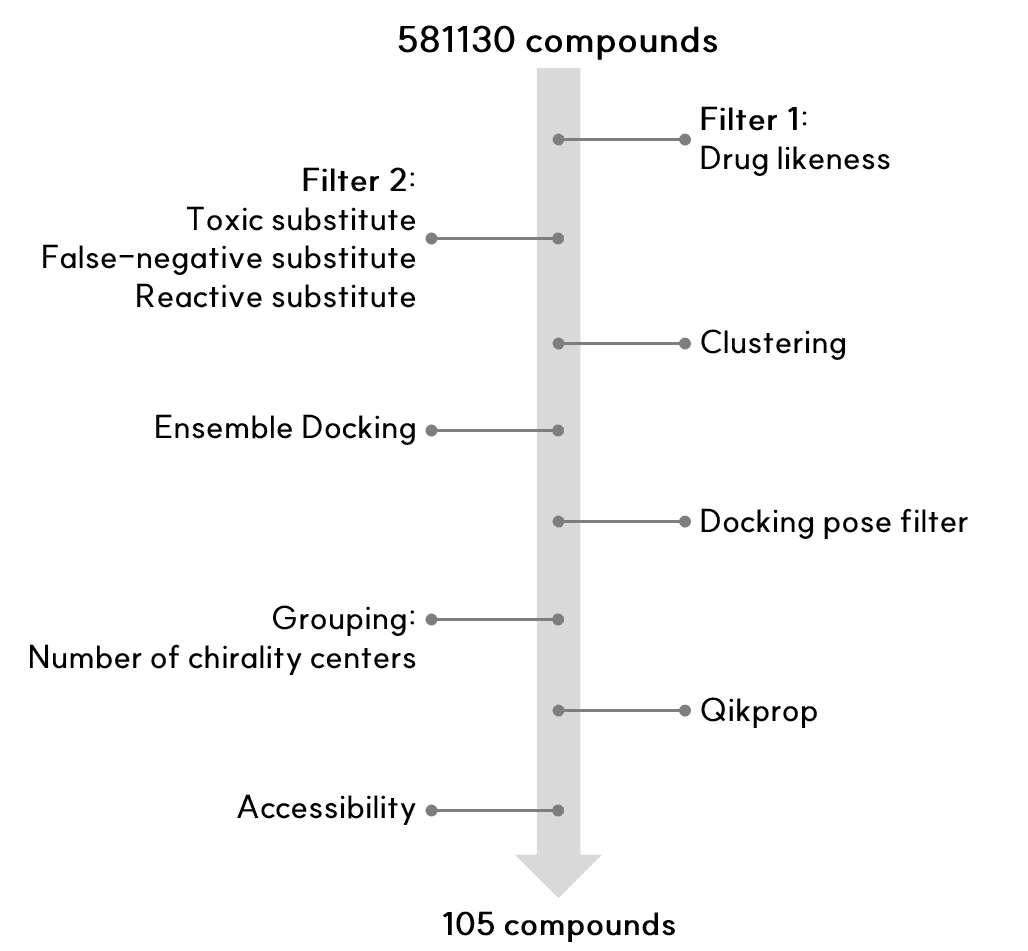
Figure 1. Computational workflow for identifying phosphorylation-state selective inhibitors of "Protein A"
Figure 2. Strategy for phosphorylation-state selective inhibition of "Protein A"
There is no major binding-site conformational changes -> Targeting the phosphorylation region
overview
This project aimed to identify small molecules that selectively inhibit the phosphorylated state of "Protein A" while sparing its unmodified form. Because no significant binding-site conformational changes were observed upon phosphorylation, we hypothesized that compounds interacting near the phosphorylation site could achieve state-selective inhibition. A large-scale virtual screening pipeline integrating cheminformatics, MD simulations, ensemble docking, interaction analysis, and ADMET assessment was developed to prioritize compounds for experimental validation.
Research Question
Can small molecules selectively target the phosphorylated state of "Protein A"?
How can phosphorylation-state selectivity be achieved when phosphorylation does not induce significant binding-site conformational changes?
Can a computational screening workflow efficiently prioritize experimentally testable compounds from a large chemical library?
Methods
Physicochemical Property Filtering
Chemical Liability Filtering
Chemical Diversity Filtering (Morgan fingerprints, similarity-based clustering)
Molecular Dynamics Simulations (Desmond)
Ensemble Docking Using Multiple Protein Conformations
Interaction-Based Prioritization
ADMET Assessment
Synthetic Feasibility and Commercial Availability Assessment
Key Findings
Developed a computational workflow to identify phosphorylation-state-selective inhibitors
Reduced an initial library of 581,130 compounds to 105 experimentally testable candidates through multi-step prioritization
Established an interaction-based screening strategy using ensemble docking and key interaction fingerprints
Prioritized compounds for biological evaluation, with experimental validation currently ongoing
My Contribution
Designed and executed the computational screening workflow, including chemical-library filtering, molecular dynamics simulations, ensemble docking, interaction-based prioritization, ADMET assessment, and final compound selection.
Current Status
Several prioritized compounds have shown activity in ongoing bioassays, supporting the utility of the computational screening strategy.


[click] ✓ Back to project list
Figure 1. Computational workflow used to identify and characterize a potential ACE2 allosteric binding mechanism.
Figure 2. Binding mode of the active compound at Allosteric Site 3
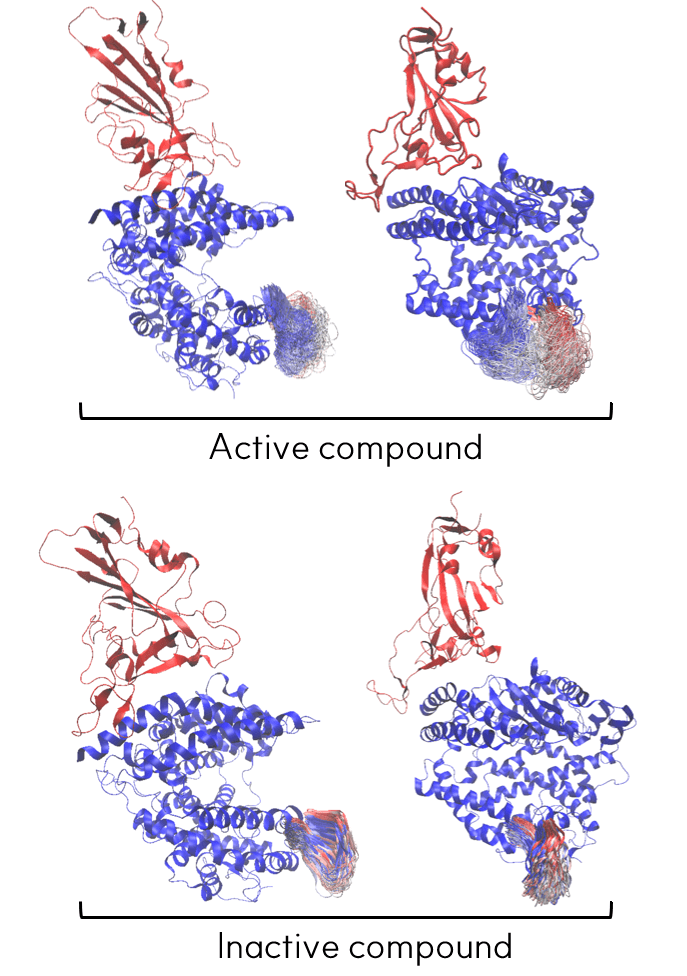
Figure 3.Comparative molecular dynamics analysis of active compounds and inactive compound, revealing ligand-dependent conformational changes in the ACE2 dimerization loop.
overview
This study investigated the molecular mechanism of a series of small molecules that inhibited the ACE2–Spike RBD interaction without substantially affecting ACE2 enzymatic activity. Three previously proposed ACE2 allosteric sites were evaluated through induced-fit docking. Allosteric site 3, located near the ACE2–RBD interface, was selected for further investigation based on the biological relevance of its location and the consistency of the predicted binding poses. Long-timescale molecular dynamics simulations were then used to compare the active compound with the structurally related but inactive compound and to examine their effects on ACE2 conformational dynamics.
Research Question
Using a panel of promising small molecules, can these compounds bind to ACE2 allosteric sites, and if so, how does this mechanistically impact RBD binding of SARS-CoV-2?
Methods
• Comparative induced-fit docking at three candidate ACE2 allosteric sites
Binding-pose and protein–ligand interaction analysis
Long-timescale molecular dynamics simulations
Comparison of active compound and inactive compound
Protein and ligand RMSD analysis
Residue-level contact and interaction analysis
Dimerization-loop conformational analysis
Structural interpretation of the ACE2–RBD disruption mechanism
Key Findings
Allosteric site 3 was selected as the most biologically relevant site for further investigation because of its proximity to the ACE2–RBD interface and the consistency of the predicted ligand poses
Active compound formed a plausible binding mode at site 3, including a π–π interaction with F390 and a hydrogen bond with N394
Active compound maintained a relatively stable binding orientation during the early and intermediate stages of the molecular dynamics simulation, followed by major ligand reorientations at later time points
The active compound-bound system displayed two pronounced periods of fluctuation in the ACE2 dimerization loop, whereas the inactive compound-bound system did not show comparable behavior
These results suggest that active compounds may modulate ACE2–RBD recognition through allosteric effects on ACE2 conformational dynamics rather than through direct inhibition of the ACE2 catalytic site
This work received a Best Poster Award and was subsequently published
My Contribution
Conducted induced-fit docking, binding-mode analysis, MM-GBSA evaluation, molecular dynamics simulations, and structural interpretation of PoMA-mediated modulation of the ACE2–Spike interface.
Research Output
Co-authored publication in Front. Pharmacol. (2026)
2024 Fall International Convention of Pharmaceutical Society of Korea - Outstanding Poster Presentation Award
Structural Modeling of the PAK4–CDK2 Interaction
Protein–protein docking analysis of the molecular interaction underlying PAK4-mediated phosphorylation of CDK2 at S106


[click] ✓ Back to project list
Figure 1. Biological rationale for modeling the PAK4–CDK2 complex.
PAK4-mediated phosphorylation of CDK2 at Ser106 has been associated with adipocyte differentiation.
Figure 2. Protein structure selection strategy.
Multiple CDK2 conformations were evaluated to examine the effects of terminal-loop structure on PAK4–CDK2 complex formation.
Figure 3. Electrostatic evaluation of a predicted PAK4–CDK2 interface.
Complementary electrostatic potentials at the candidate interface support the structural plausibility of the docking model
overview
PAK4 was experimentally identified as a kinase that phosphorylates CDK2 at S106 during early adipocyte differentiation. I conducted the computational component of this collaborative study to determine whether this phosphorylation mechanism was structurally feasible. Alternative CDK2 structures and terminal-loop conformations were evaluated, followed by restraint-guided protein–protein docking and interface analysis of the PAK4–CDK2 complex.
Research Question
Can PAK4 form a structurally and electrostatically compatible complex with CDK2 that enables phosphorylation at S106?
Methods
CDK2 structure and terminal-loop comparison
Protein preparation and structure selection
Restraint-guided protein–protein docking with PIPER
Docking-model clustering and prioritization
Structural minimization with Desmond
Surface and electrostatic interface analysis
Molecular visualization with PyMOL
Key Findings
Identified a CDK2 conformation in which S106 remained accessible to PAK4.
Generated a docking model that positioned PAK4 pS474 near CDK2 S106 in a phosphorylation-compatible geometry.
Observed substantial surface and electrostatic complementarity at the predicted protein–protein interface.
Provided a structural rationale supporting the experimentally identified PAK4-mediated phosphorylation of CDK2 at S106.
My Contribution
I conducted the computational component of this collaborative study, including CDK2 structure and loop-conformation assessment, restraint-guided PAK4–CDK2 protein–protein docking, model clustering and prioritization, interface analysis, electrostatic evaluation, structural minimization, and molecular visualization.
Research Output
Co-authored publication in Experimental & Molecular Medicine (2025)
Responsible for the computational modeling and structural analysis presented in the study.